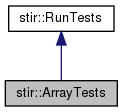
Tests Array functionality. More...
Public Member Functions | |
| void | run_tests () override |
| Function (to be overloaded) which does the actual tests. | |
 Public Member Functions inherited from stir::RunTests Public Member Functions inherited from stir::RunTests | |
| RunTests (const double tolerance=1E-4) | |
| Default constructor. | |
| virtual | ~RunTests () |
| Destructor, outputs a diagnostic message. | |
| bool | is_everything_ok () const |
| Returns if all checks were fine upto now. | |
| int | main_return_value () const |
| Handy return value for a main() function. | |
| void | set_tolerance (const double tolerance) |
| Set value used in floating point comparisons (see check_* functions) | |
| double | get_tolerance () const |
| Get value used in floating point comparisons (see check_* functions) | |
| bool | check (const bool, const std::string &str="") |
| Tests if true, str can be used to tell what you are testing. | |
| bool | check_if_equal (const std::string &a, const std::string &b, const std::string &str="") |
| bool | check_if_equal (const double a, const double b, const std::string &str="") |
| bool | check_if_equal (const short a, const short b, const std::string &str="") |
| bool | check_if_equal (const unsigned short a, const unsigned short b, const std::string &str="") |
| bool | check_if_equal (const int a, const int b, const std::string &str="") |
| bool | check_if_equal (const unsigned int a, const unsigned int b, const std::string &str="") |
| bool | check_if_equal (const long a, const long b, const std::string &str="") |
| bool | check_if_equal (const unsigned long a, const unsigned long b, const std::string &str="") |
| bool | check_if_equal (const Bin &a, const Bin &b, const std::string &str="") |
| template<class T> | |
| bool | check_if_equal (const DetectionPosition< T > &a, const DetectionPosition< T > &b, const std::string &str="") |
| template<class T> | |
| bool | check_if_equal (const std::complex< T > a, const std::complex< T > b, const std::string &str="") |
| check equality by calling check_if_equal on real and imaginary parts | |
| template<class T> | |
| bool | check_if_equal (const VectorWithOffset< T > &t1, const VectorWithOffset< T > &t2, const std::string &str="") |
| check equality by comparing ranges and calling check_if_equal on all elements | |
| template<class T> | |
| bool | check_if_equal (const std::vector< T > &t1, const std::vector< T > &t2, const std::string &str="") |
| check equality by comparing size and calling check_if_equal on all elements | |
| bool | check_if_equal (const ProjDataInMemory &t1, const ProjDataInMemory &t2, const std::string &str="") |
| template<int n> | |
| bool | check_if_equal (const IndexRange< n > &t1, const IndexRange< n > &t2, const std::string &str="") |
| template<int num_dimensions, class coordT> | |
| bool | check_if_equal (const BasicCoordinate< num_dimensions, coordT > &a, const BasicCoordinate< num_dimensions, coordT > &b, const std::string &str="") |
| check equality by comparing norm(a-b) with tolerance | |
| bool | check_if_zero (const double a, const std::string &str="") |
| bool | check_if_zero (const short a, const std::string &str="") |
| bool | check_if_zero (const unsigned short a, const std::string &str="") |
| bool | check_if_zero (const int a, const std::string &str="") |
| bool | check_if_zero (const unsigned int a, const std::string &str="") |
| bool | check_if_zero (const long a, const std::string &str="") |
| bool | check_if_zero (const unsigned long a, const std::string &str="") |
| template<class T> | |
| bool | check_if_zero (const VectorWithOffset< T > &t, const std::string &str="") |
| use check_if_zero on all elements | |
| template<int num_dimensions, class coordT> | |
| bool | check_if_zero (const BasicCoordinate< num_dimensions, coordT > &a, const std::string &str="") |
| compare norm with tolerance | |
| template<class T1, class T2> | |
| bool | check_if_less (T1 a, T2 b, const std::string &str="") |
| check if a<b | |
Detailed Description
Tests Array functionality.
- Warning
- Running this will create and delete 2 files with names output.flt and output.other. Existing files with these names will be overwritten.
Member Function Documentation
◆ run_tests()
|
overridevirtual |
Function (to be overloaded) which does the actual tests.
This function is expected to do a series of calls to check(), check_if_equal() etc.
Implements stir::RunTests.
References _PI, stir::Array< num_dimensions, elemT >::axpby(), stir::VectorWithOffset< T >::begin(), stir::Array< num_dimensions, elemT >::begin_all(), stir::Array< num_dimensions, elemT >::begin_all_const(), stir::RunTests::check(), stir::RunTests::check_if_zero(), stir::copy_to(), stir::Array< num_dimensions, elemT >::end_all(), stir::Array< num_dimensions, elemT >::end_all_const(), stir::Array< num_dimensions, elemT >::fill(), stir::fill_from(), stir::Array< num_dimensions, elemT >::find_max(), stir::Array< num_dimensions, elemT >::find_min(), stir::Array< num_dimensions, elemT >::get_const_full_data_ptr(), stir::Array< num_dimensions, elemT >::get_full_data_ptr(), stir::VectorWithOffset< T >::get_max_index(), stir::VectorWithOffset< T >::get_min_index(), stir::Array< num_dimensions, elemT >::get_regular_range(), stir::Array< num_dimensions, elemT >::grow(), stir::in_place_apply_function(), stir::in_place_exp(), stir::in_place_log(), stir::Array< num_dimensions, elemT >::is_contiguous(), stir::Array< num_dimensions, elemT >::is_regular(), stir::VectorWithOffset< T >::owns_memory_for_data(), stir::Array< num_dimensions, elemT >::release_const_full_data_ptr(), stir::Array< num_dimensions, elemT >::release_full_data_ptr(), stir::HighResWallClockTimer::reset(), stir::Array< num_dimensions, elemT >::resize(), stir::Array< num_dimensions, elemT >::sapyb(), stir::VectorWithOffset< T >::size(), stir::Array< num_dimensions, elemT >::size_all(), stir::IndexRange< num_dimensions >::size_all(), stir::HighResWallClockTimer::start(), stir::HighResWallClockTimer::stop(), stir::Array< num_dimensions, elemT >::sum(), stir::sum(), stir::HighResWallClockTimer::value(), and stir::Array< num_dimensions, elemT >::xapyb().
The documentation for this class was generated from the following file:
- /home/kris/devel/STIRdistrib/STIR/src/test/test_Array.cxx
Generated on Wed May 27 2026 17:04:06 for STIR by
 1.13.2