This class can be used to store 'factories' and their corresponding keys. It is essentially a map, but with some extra embelishments. More...
#include "stir/FactoryRegistry.h"
Public Member Functions | |
| FactoryRegistry () | |
| Default constructor without defaults (see find_factory()). | |
| FactoryRegistry (const Key &default_key, const Factory &default_factory) | |
| constructor with default values which will be returned when no match is found (see find_factory()) | |
| void | add_to_registry (const Key &key, Factory const &factory) |
| Add a pair to the registry. | |
| void | remove_from_registry (const Key &key) |
| Remove a pair from the registry. | |
| void | list_keys (std::ostream &s) const |
| List all keys to an ostream, separated by newlines. | |
| Factory const & | find_factory (const Key &key) const |
| Find a factory corresponding to a key. | |
Detailed Description
class stir::FactoryRegistry< Key, Factory, Compare >
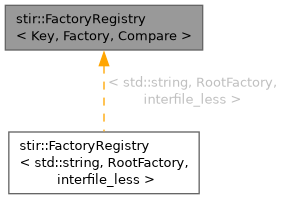
This class can be used to store 'factories' and their corresponding keys. It is essentially a map, but with some extra embelishments.
A factory is supposed to be an object which can create another object, although this is not really enfored by the implementation of FactoryRegistry.
- Type requirements
Key,Factory,Compare must be suitable as defined for std::map. In addition, FactoryRegistry::list_keys() requires that operator<<(ostream&, const Key&) is defined.
- Todo
- Probably it would be better to store pointers to factories. However, in that case, the destructor of FactoryRegistry would have to deallocate these factory objects. This would mean that factories have to be allocated with new, and hence would prevent using simple function pointers.
Constructor & Destructor Documentation
◆ FactoryRegistry() [1/2]
|
inline |
Default constructor without defaults (see find_factory()).
References FactoryRegistry().
Referenced by FactoryRegistry().
◆ FactoryRegistry() [2/2]
|
inline |
constructor with default values which will be returned when no match is found (see find_factory())
References add_to_registry().
Member Function Documentation
◆ add_to_registry()
|
inline |
Add a pair to the registry.
Adding the same key twice will overwrite the first value.
References stir::warning().
Referenced by FactoryRegistry().
◆ remove_from_registry()
|
inline |
Remove a pair from the registry.
References stir::warning().
◆ list_keys()
|
inline |
List all keys to an ostream, separated by newlines.
Referenced by find_factory().
◆ find_factory()
|
inline |
Find a factory corresponding to a key.
If the key is not found, the behaviour depends on which constructor was used. If the (default) no-argument constructor is used, an error message is printed, and the program aborts. If the 2nd constructor with default values, the default_factory is returned.
References stir::error(), and list_keys().
Referenced by stir::RegisteredObject< Root >::read_registered_object().
The documentation for this class was generated from the following files:
- /home/kris/devel/STIRdistrib/STIR/src/include/stir/FactoryRegistry.h
- /home/kris/devel/STIRdistrib/STIR/src/include/stir/FactoryRegistry.inl
Generated on for STIR by
 1.18.0