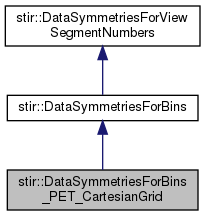
Symmetries appropriate for a (cylindrical) PET scanner, and a discretised density on a Cartesian grid. More...
#include "stir/recon_buildblock/DataSymmetriesForBins_PET_CartesianGrid.h"
Public Member Functions | |
| DataSymmetriesForBins_PET_CartesianGrid (const shared_ptr< const ProjDataInfo > &proj_data_info_ptr, const shared_ptr< const DiscretisedDensity< 3, float > > &image_info_ptr, const bool do_symmetry_90degrees_min_phi=true, const bool do_symmetry_180degrees_min_phi=true, const bool do_symmetry_swap_segment=true, const bool do_symmetry_swap_s=true, const bool do_symmetry_shift_z=true) | |
| Constructor with optional selection of symmetries. | |
| DataSymmetriesForBins_PET_CartesianGrid * | clone () const override |
| virtual bool | operator== (const DataSymmetriesForBins_PET_CartesianGrid &) const |
| Check equality. | |
| void | get_related_bins_factorised (std::vector< AxTangPosNumbers > &, const Bin &b, const int min_axial_pos_num, const int max_axial_pos_num, const int min_tangential_pos_num, const int max_tangential_pos_num) const override |
| fills in a vector with the axial and tangential position numbers related to this bin | |
| int | num_related_bins (const Bin &b) const override |
| returns the number of bins related to 'b' | |
| unique_ptr< SymmetryOperation > | find_symmetry_operation_from_basic_bin (Bin &) const override |
| given an arbitrary bin 'b', find the basic bin and the corresponding symmetry operation | |
| bool | find_basic_bin (Bin &b) const override |
| given an arbitrary bin 'b', find the basic bin | |
| int | num_related_view_segment_numbers (const ViewSegmentNumbers &vs) const override |
| returns the number of view_segment_numbers related to 'v_s' | |
| void | get_related_view_segment_numbers (std::vector< ViewSegmentNumbers > &rel_vs, const ViewSegmentNumbers &vs) const override |
| fills in a vector with all the view/segments that are related to 'v_s' (including itself) | |
| bool | find_basic_view_segment_numbers (ViewSegmentNumbers &v_s) const override |
| given an arbitrary view/segment, find the basic view/segment | |
| float | get_num_planes_per_scanner_ring () const |
| find out how many image planes there are for every scanner ring | |
| float | get_num_planes_per_axial_pos (const int segment_num) const |
| find correspondence between axial_pos_num and image coordinates | |
| float | get_axial_pos_to_z_offset (const int segment_num) const |
 Public Member Functions inherited from stir::DataSymmetriesForBins Public Member Functions inherited from stir::DataSymmetriesForBins | |
| DataSymmetriesForBins (const shared_ptr< const ProjDataInfo > &proj_data_info_ptr) | |
| void | get_related_bins (std::vector< Bin > &, const Bin &b) const |
| fills in a vector with all the bins that are related to 'b' (including itself) | |
| virtual void | get_related_bins (std::vector< Bin > &, const Bin &b, const int min_axial_pos_num, const int max_axial_pos_num, const int min_tangential_pos_num, const int max_tangential_pos_num, const int min_timing_pos_num, const int max_timing_pos_num) const |
| fills in a vector with all the bins (within the range) that are related to 'b' | |
| void | get_related_bins_factorised (std::vector< AxTangPosNumbers > &, const Bin &b) const |
| fills in a vector with the axial and tangential position numbers related to this bin | |
| virtual bool | is_basic (const Bin &v_s) const |
| test if a bin is 'basic' | |
| virtual unique_ptr< SymmetryOperation > | find_symmetry_operation_from_basic_view_segment_numbers (ViewSegmentNumbers &) const |
| default implementation in terms of find_symmetry_operation_from_basic_bin | |
| Public Member Functions inherited from stir::DataSymmetriesForViewSegmentNumbers | |
| bool | operator== (const DataSymmetriesForViewSegmentNumbers &) const |
| Check equality. | |
| bool | operator!= (const DataSymmetriesForViewSegmentNumbers &) const |
| Check inequality. | |
| std::size_t | num_related_viewgram_indices (const ViewgramIndices &ind) const |
| virtual bool | is_basic (const ViewSegmentNumbers &v_s) const |
| test if a view/segment is 'basic' | |
Additional Inherited Members | |
| Protected Types inherited from stir::DataSymmetriesForViewSegmentNumbers | |
| typedef DataSymmetriesForViewSegmentNumbers | root_type |
| Protected Attributes inherited from stir::DataSymmetriesForBins | |
| const shared_ptr< const ProjDataInfo > | proj_data_info_ptr |
| Member storing the info needed by get_related_bins() et al. | |
Detailed Description
Symmetries appropriate for a (cylindrical) PET scanner, and a discretised density on a Cartesian grid.
Nearly all operations (except the constructor) are inline as timing of the methods of this class is critical.
Constructor & Destructor Documentation
◆ DataSymmetriesForBins_PET_CartesianGrid()
| stir::DataSymmetriesForBins_PET_CartesianGrid::DataSymmetriesForBins_PET_CartesianGrid | ( | const shared_ptr< const ProjDataInfo > & | proj_data_info_ptr, |
| const shared_ptr< const DiscretisedDensity< 3, float > > & | image_info_ptr, | ||
| const bool | do_symmetry_90degrees_min_phi_v = true, | ||
| const bool | do_symmetry_180degrees_min_phi_v = true, | ||
| const bool | do_symmetry_swap_segment_v = true, | ||
| const bool | do_symmetry_swap_s_v = true, | ||
| const bool | do_symmetry_shift_z = true ) |
Constructor with optional selection of symmetries.
For the azimuthal angle phi, the following angles are symmetry related for a square grid: {phi, 180-phi, 90-phi, 90+phi}. The boolean parameters allow to select which angles should be considered as related:
-
azimuthal
- all 4: (do_symmetry_90degrees_min_phi=true)
- only {phi, 180-phi} : (do_symmetry_90degrees_min_phi=false, do_symmetry_180degrees_min_phi = true)
- none: (do_symmetry_90degrees_min_phi=false, do_symmetry_180degrees_min_phi = false)
- axial (i.e. positive vs. negative segment): do_symmetry_swap_segment
- tangential (i.e. positive vs negative s): do_symmetry_swap_s
- axial shift do_symmetry_shift_z
Note that when do_symmetry_90degrees_min_phi=true, the value of do_symmetry_180degrees_min_phi is irrelevant. This is because otherwise a non-consecutive range in phi would have to be used.
The symmetry in phi is automatically reduced for non-square grids or when the number of views is not a multiple of 4.
The DiscretisedDensity pointer has to point to an object of type DiscretisedDensityOnCartesianGrid (or a derived type).
We really need only the geometrical info from the image. At the moment we have to use the data itself as well.
References DataSymmetriesForBins_PET_CartesianGrid(), stir::error(), stir::get(), stir::info(), stir::DataSymmetriesForBins::proj_data_info_ptr, and stir::warning().
Referenced by DataSymmetriesForBins_PET_CartesianGrid(), and operator==().
Member Function Documentation
◆ clone()
|
overridevirtual |
Implements stir::DataSymmetriesForBins.
◆ get_related_bins_factorised()
|
inlineoverridevirtual |
fills in a vector with the axial and tangential position numbers related to this bin
It is guaranteed (or at least, it should be by the implementation of the derived class) that these AxTangPosNumbers are related for all related ViewSegmentNumbers for this bin.
So, you can find all related bins by calling get_related_ViewSegmentNumbers() and get_related_bins_factorised(), which is what the default implementation does. (A derived class might do this in a more optimal way.)
- Warning
bhas to be a 'basic' bin
Implements stir::DataSymmetriesForBins.
References stir::Bin::axial_pos_num(), find_basic_bin(), get_related_bins_factorised(), stir::DataSymmetriesForBins::proj_data_info_ptr, stir::SegmentIndices::segment_num(), stir::Bin::tangential_pos_num(), and stir::ViewgramIndices::view_num().
Referenced by get_related_bins_factorised().
◆ num_related_bins()
|
inlineoverridevirtual |
returns the number of bins related to 'b'
default implementation in terms of get_related_bins, will be slow of course
Reimplemented from stir::DataSymmetriesForBins.
References stir::Bin::axial_pos_num(), stir::ProjDataInfoCylindrical::get_ring_pair_for_segment_axial_pos_num(), num_related_bins(), stir::DataSymmetriesForBins::proj_data_info_ptr, stir::SegmentIndices::segment_num(), stir::Bin::tangential_pos_num(), and stir::ViewgramIndices::view_num().
Referenced by num_related_bins().
◆ find_symmetry_operation_from_basic_bin()
|
inlineoverridevirtual |
given an arbitrary bin 'b', find the basic bin and the corresponding symmetry operation
sets 'b' to the corresponding 'basic' bin and returns the symmetry transformation from 'basic' to 'b'.
Implements stir::DataSymmetriesForBins.
References stir::Bin::axial_pos_num(), find_basic_bin(), find_symmetry_operation_from_basic_bin(), stir::SegmentIndices::segment_num(), stir::Bin::tangential_pos_num(), and stir::ViewgramIndices::view_num().
Referenced by find_symmetry_operation_from_basic_bin().
◆ find_basic_bin()
|
inlineoverridevirtual |
given an arbitrary bin 'b', find the basic bin
sets 'b' to the corresponding 'basic' bin and returns true if 'b' is changed (i.e. it was NOT a basic bin).
default implementation in terms of find_symmetry_operation_from_basic_bin
Reimplemented from stir::DataSymmetriesForBins.
References stir::Bin::axial_pos_num(), find_basic_bin(), stir::SegmentIndices::segment_num(), stir::Bin::tangential_pos_num(), stir::SegmentIndices::timing_pos_num(), and stir::ViewgramIndices::view_num().
Referenced by find_basic_bin(), find_symmetry_operation_from_basic_bin(), and get_related_bins_factorised().
◆ num_related_view_segment_numbers()
|
inlineoverridevirtual |
returns the number of view_segment_numbers related to 'v_s'
The default implementation is in terms of get_related_view_segment_numbers, which will be slow of course
Reimplemented from stir::DataSymmetriesForViewSegmentNumbers.
References num_related_view_segment_numbers(), stir::SegmentIndices::segment_num(), and stir::ViewgramIndices::view_num().
Referenced by get_related_view_segment_numbers(), and num_related_view_segment_numbers().
◆ get_related_view_segment_numbers()
|
inlineoverridevirtual |
fills in a vector with all the view/segments that are related to 'v_s' (including itself)
Implements stir::DataSymmetriesForViewSegmentNumbers.
References find_basic_view_segment_numbers(), get_related_view_segment_numbers(), num_related_view_segment_numbers(), stir::SegmentIndices::segment_num(), and stir::ViewgramIndices::view_num().
Referenced by get_related_view_segment_numbers().
◆ find_basic_view_segment_numbers()
|
inlineoverridevirtual |
given an arbitrary view/segment, find the basic view/segment
sets 'v_s' to the corresponding 'basic' view/segment and returns true if 'v_s' is changed (i.e. it was NOT a basic view/segment).
Implements stir::DataSymmetriesForViewSegmentNumbers.
References find_basic_view_segment_numbers(), stir::SegmentIndices::segment_num(), and stir::ViewgramIndices::view_num().
Referenced by find_basic_view_segment_numbers(), and get_related_view_segment_numbers().
◆ get_num_planes_per_axial_pos()
|
inline |
find correspondence between axial_pos_num and image coordinates
z = num_planes_per_axial_pos * axial_pos_num + axial_pos_to_z_offset
compute the offset by matching up the centre of the scanner in the 2 coordinate systems
References get_num_planes_per_axial_pos().
Referenced by get_num_planes_per_axial_pos().
The documentation for this class was generated from the following files:
- /home/kris/devel/STIRdistrib/STIR/src/include/stir/recon_buildblock/DataSymmetriesForBins_PET_CartesianGrid.h
- /home/kris/devel/STIRdistrib/STIR/src/include/stir/recon_buildblock/DataSymmetriesForBins_PET_CartesianGrid.inl
- /home/kris/devel/STIRdistrib/STIR/src/recon_buildblock/DataSymmetriesForBins_PET_CartesianGrid.cxx
Generated on Wed May 27 2026 17:04:06 for STIR by
 1.13.2