This class is used to bin listmode data to projection data, i.e. (3d) sinograms. More...
#include "stir/listmode/LmToProjData.h"
Public Member Functions | |
| LmToProjData (const char *const par_filename) | |
| Constructor taking a filename for a parameter file. | |
| LmToProjData () | |
| Default constructor. | |
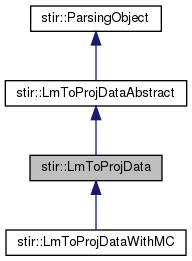
 Public Member Functions inherited from stir::LmToProjDataAbstract Public Member Functions inherited from stir::LmToProjDataAbstract | |
| ~LmToProjDataAbstract () override | |
| Destructor. | |
| Public Member Functions inherited from stir::ParsingObject | |
| ParsingObject (const ParsingObject &) | |
| ParsingObject & | operator= (const ParsingObject &) |
| bool | parse (std::istream &f) |
| bool | parse (const char *const filename) |
| void | ask_parameters () |
| virtual std::string | parameter_info () |
Protected Member Functions | |
parsing functions | |
| void | set_defaults () override |
| Set defaults before parsing. | |
| void | initialise_keymap () override |
| Initialise all keywords. | |
| bool | post_processing () override |
| This will be called at the end of the parsing. | |
| virtual void | set_key_values () |
| This will be called before parsing or parameter_info is called. | |
Protected Attributes | |
parsing variables | |
| std::string | input_filename |
| std::string | output_filename_prefix |
| std::string | template_proj_data_name |
| std::string | frame_definition_filename |
| frame definitions | |
| bool | do_pre_normalisation |
| bool | store_prompts |
| bool | store_delayeds |
| int | num_segments_in_memory |
| int | num_timing_poss_in_memory |
| long int | num_events_to_store |
| int | max_segment_num_to_process |
| bool | interactive |
| Toggle readable output on stdout or actual projdata. | |
| shared_ptr< ProjDataInfo > | template_proj_data_info_ptr |
| shared_ptr< BinNormalisation > | normalisation_ptr |
| This will be used for pre-normalisation. | |
| shared_ptr< BinNormalisation > | post_normalisation_ptr |
| This will be used for post-normalisation. | |
| shared_ptr< ProjData > | output_proj_data_sptr |
| This will be used to return the output directly, if set. | |
| shared_ptr< ListModeData > | lm_data_ptr |
| Pointer to the actual data. | |
| TimeFrameDefinitions | frame_defs |
| Time frames. | |
| double | current_time |
| stores the time (in secs) recorded in the previous timing event | |
| unsigned int | current_frame_num |
| stores the current frame number | |
| shared_ptr< const ProjDataInfo > | proj_data_info_cyl_uncompressed_ptr |
| Internal variable that will be used for pre-normalisation. | |
| bool | do_time_frame |
| variable that will be set according to if we are using time frames or num_events_to_store | |
| int | delayed_increment |
| A variable that will be set to 1,0 or -1, according to store_prompts and store_delayeds. | |
| bool | _already_setup |
| an internal bool variable to check if the object has been set-up or not | |
| KeyParser | parser |
Functions to get/set parameters | |
This can be used as alternative to the parsing mechanism.
| |
| void | set_template_proj_data_info_sptr (shared_ptr< const ProjDataInfo >) |
Optional proj data_info to use as "template". | |
| shared_ptr< const ProjDataInfo > | get_template_proj_data_info_sptr () const |
| Get the current template. | |
| virtual void | set_input_data (const shared_ptr< ExamData > &) |
| set input data | |
| virtual void | set_input_data (const std::string &filename) |
| set input data | |
| void | set_output_filename_prefix (const std::string &) |
| std::string | get_output_filename_prefix () const |
| void | set_output_projdata_sptr (shared_ptr< ProjData > &) |
| set projdata to be filled with output | |
| void | set_store_prompts (bool) |
| bool | get_store_prompts () const |
| void | set_store_delayeds (bool) |
| bool | get_store_delayeds () const |
| double | get_last_processed_lm_rel_time () const |
| Returns the last processed timestamp in the listmode file. | |
| void | set_num_segments_in_memory (int) |
| int | get_num_segments_in_memory () const |
| void | set_num_events_to_store (long int) |
| long int | get_num_events_to_store () const |
| void | set_time_frame_definitions (const TimeFrameDefinitions &) |
| const TimeFrameDefinitions & | get_time_frame_definitions () const |
| virtual Succeeded | set_up () override |
| Perform various checks. | |
| virtual void | process_data () override |
| This function does the actual work. | |
| virtual void | start_new_time_frame (const unsigned int new_frame_num) |
| will be called when a new time frame starts | |
| virtual void | process_new_time_event (const ListTime &) |
| will be called after a new timing event is found in the file | |
| virtual void | get_bin_from_event (Bin &bin, const ListEvent &) const |
| will be called to get the bin for a coincidence event | |
| int | get_compression_count (const Bin &bin) const |
| A function that should return the number of uncompressed bins in the current bin. | |
| void | do_post_normalisation (Bin &bin) const |
| Computes a post-normalisation factor (if any) for this bin. | |
Detailed Description
This class is used to bin listmode data to projection data, i.e. (3d) sinograms.
It provides the basic machinery to go through a list mode data file, and write projection data for each time frame.
The class can parse its parameters from an input file. This has the following format:
lm_to_projdata Parameters:=

input file := some_lm_file
output filename prefix := my_favorite_name_for_the_projdata

; parameters that determine the sizes etc of the output

  ; Optional projection data to use as "template", i.e. the output
  ; will have the same size.
  ; If none is specified, we will use the proj_data_info from the input list-mode.
  ; Warning: for some scanners with TOF capabilities, this will result in very
  ; large projection data (possibly larger than the default from the vendor).
  template_projdata := some_projdata_file
  ; the next can be used to use a smaller number of segments than given
  ; in the template
  maximum absolute segment number to process :=

; parameters for saying which events will be stored

  ; time frames (see TimeFrameDefinitions doc for format)
  frame_definition file := frames.fdef
  ; or a total number of events (if  larger than 0, frame definitions will be ignored)
  ; note that this normally counts the total of prompts-delayeds (see below)
  num_events_to_store := -1

; parameters relating to prompts and delayeds

  ; with the default values, prompts will be added and delayed subtracted
  ; to give the usual estimate of the trues.

  ; store the prompts (value should be 1 or 0)
  store prompts := 1  ;default
  ; what to do if it's a delayed event
  store delayeds := 1  ;default


; parameters related to normalisation
; default settings mean no normalisation
; Use with care!

  ; in pre normalisation, each event will contribute its
  ; 'normalisation factor' to the bin
  ; in post normalisation, an average factor for the bin will be used
  do pre normalisation  := 0 ; default is 0
  ; type of pre-normalisation (see BinNormalisation doc)
  Bin Normalisation type for pre-normalisation := None ; default
  ; type of post-normalisation (see BinNormalisation doc)
  Bin Normalisation type for post-normalisation := None ; default

; miscellaneous parameters

  ; list each event on stdout and do not store any files (use only for testing!)
  ; has to be 0 or 1
  List event coordinates := 0

  ; if you're short of RAM (i.e. a single projdata does not fit into memory),
  ; you can use this to process the list mode data in multiple passes.
  num_segments_in_memory := -1
  ; same for TOF bins
  num_TOF_bins_in_memory := 1
End :=
Hopefully the only thing that needs explaining are the parameters related to prompts and delayeds. These are used to allow different ways of processing the data. There are really only 3 useful cases:
-
'online' subtraction of delayeds
This is the default, and adds prompts but subtracts delayeds.store prompts := 1store delayeds := 1 -
store prompts only
Usestore prompts := 1store delayeds := 0 -
store delayeds only
UseNote that now the delayed events will be added, not subtracted.store prompts := 0store delayeds := 1
- Notes for developers
The class provides several virtual functions. If a derived class overloads these, the default behaviour might change. For example, get_bin_from_event() might do motion correction.
- Todo
Currently, there is no support for gating or energy windows. This could in principle be added by a derived class, but it would be better to do it here.
Timing info or so for get_bin_from_event() for rotating scanners etc.
There is overlap between the normalisation and the current treatment of bin.get_bin_value(). This is really because we should be using something like a EventNormalisation class for pre-normalisation.
- See also
- ListModeData for more info on list mode data.
Constructor & Destructor Documentation
◆ LmToProjData() [1/2]
| stir::LmToProjData::LmToProjData | ( | const char *const | par_filename | ) |
Constructor taking a filename for a parameter file.
Will attempt to open and parse the file.
References stir::error(), LmToProjData(), and set_defaults().
Referenced by LmToProjData(), and LmToProjData().
◆ LmToProjData() [2/2]
| stir::LmToProjData::LmToProjData | ( | ) |
Default constructor.
- Warning
- leaves parameters ill-defined. Set them by parsing.
References LmToProjData(), and set_defaults().
Member Function Documentation
◆ set_template_proj_data_info_sptr()
| void stir::LmToProjData::set_template_proj_data_info_sptr | ( | shared_ptr< const ProjDataInfo > | t_sptr | ) |
Optional proj data_info to use as "template".
Use this to specify the output output proj_data_info, i.e. the output will have the same size.
If not set, or when setting it explicitly to 0, the proj_data_info from the input list-mode will be used.
Warning: for some scanners with TOF capabilities, this will result in large projection data (possibly larger than the default from the vendor).
References _already_setup, and set_template_proj_data_info_sptr().
Referenced by post_processing(), set_template_proj_data_info_sptr(), and set_up().
◆ get_template_proj_data_info_sptr()
| shared_ptr< const ProjDataInfo > stir::LmToProjData::get_template_proj_data_info_sptr | ( | ) | const |
Get the current template.
- Warning
- the return value can be the null pointer.
References get_template_proj_data_info_sptr().
Referenced by get_template_proj_data_info_sptr().
◆ set_input_data() [1/2]
|
virtual |
set input data
will throw of the input data is not of type ListModeData
References _already_setup, stir::error(), lm_data_ptr, set_input_data(), and stir::warning().
Referenced by post_processing(), set_input_data(), and set_input_data().
◆ set_input_data() [2/2]
|
virtual |
set input data
will throw of the input data is not of type ListModeData
References stir::read_from_file(), and set_input_data().
◆ set_output_projdata_sptr()
| void stir::LmToProjData::set_output_projdata_sptr | ( | shared_ptr< ProjData > & | arg | ) |
set projdata to be filled with output
will only store data from the last defined time frame!
References output_proj_data_sptr, and set_output_projdata_sptr().
Referenced by set_output_projdata_sptr().
◆ get_last_processed_lm_rel_time()
| double stir::LmToProjData::get_last_processed_lm_rel_time | ( | ) | const |
Returns the last processed timestamp in the listmode file.
This can be used to find the duration (in seconds) of the last time frame processed.
References current_time, and get_last_processed_lm_rel_time().
Referenced by get_last_processed_lm_rel_time().
◆ set_up()
|
overridevirtual |
Perform various checks.
Will likely call error() if there is a problem.
Reimplemented from stir::LmToProjDataAbstract.
Reimplemented in stir::LmToProjDataWithMC.
References _already_setup, delayed_increment, do_time_frame, stir::error(), frame_definition_filename, frame_defs, stir::info(), interactive, lm_data_ptr, normalisation_ptr, post_normalisation_ptr, proj_data_info_cyl_uncompressed_ptr, stir::ProjDataInfo::ProjDataInfoCTI(), set_template_proj_data_info_sptr(), set_up(), and stir::warning().
Referenced by post_processing(), and set_up().
◆ process_data()
|
overridevirtual |
This function does the actual work.
You need to call set_up() first.
Implements stir::LmToProjDataAbstract.
References _already_setup, stir::Bin::axial_pos_num(), current_frame_num, current_time, delayed_increment, do_post_normalisation(), do_time_frame, stir::error(), frame_defs, get_bin_from_event(), stir::Bin::get_bin_value(), stir::VectorWithOffset< T >::get_max_index(), stir::VectorWithOffset< T >::get_min_index(), stir::Scanner::get_name(), interactive, stir::ListEvent::is_valid_template(), lm_data_ptr, output_proj_data_sptr, stir::Scanner::parameter_info(), process_data(), process_new_time_event(), stir::VectorWithOffset< T >::resize(), stir::SegmentIndices::segment_num(), stir::Bin::set_bin_value(), stir::Timer::start(), start_new_time_frame(), stir::Timer::stop(), stir::Bin::tangential_pos_num(), stir::Bin::time_frame_num(), stir::SegmentIndices::timing_pos_num(), stir::Timer::value(), stir::ViewgramIndices::view_num(), and stir::warning().
Referenced by process_data().
◆ start_new_time_frame()
|
protectedvirtual |
will be called when a new time frame starts
The frame numbers start from 1.
Reimplemented in stir::LmToProjDataWithMC.
References start_new_time_frame().
Referenced by process_data(), start_new_time_frame(), and stir::LmToProjDataWithMC::start_new_time_frame().
◆ process_new_time_event()
|
protectedvirtual |
will be called after a new timing event is found in the file
Reimplemented in stir::LmToProjDataWithMC.
References process_new_time_event().
Referenced by process_data(), and process_new_time_event().
◆ get_bin_from_event()
|
protectedvirtual |
will be called to get the bin for a coincidence event
If bin.get_bin_value()<=0, the event will be ignored. Otherwise, the value will be used as a bin-normalisation factor (on top of anything done by normalisation_ptr).
- Todo
- Would need timing info or so for e.g. time dependent normalisation or angle info for a rotating scanner.
References stir::Bin::axial_pos_num(), get_bin_from_event(), stir::Bin::get_bin_value(), normalisation_ptr, proj_data_info_cyl_uncompressed_ptr, stir::SegmentIndices::segment_num(), stir::Bin::set_bin_value(), stir::Bin::tangential_pos_num(), stir::ViewgramIndices::view_num(), and stir::warning().
Referenced by get_bin_from_event(), and process_data().
◆ get_compression_count()
|
protected |
A function that should return the number of uncompressed bins in the current bin.
- Todo
- it is not compatiable with e.g. HiDAC doesn't belong here anyway (more ProjDataInfo?)
References stir::Bin::axial_pos_num(), get_compression_count(), stir::ProjDataInfoCylindrical::get_num_ring_pairs_for_segment_axial_pos_num(), stir::ProjDataInfoCylindrical::get_view_mashing_factor(), and stir::SegmentIndices::segment_num().
Referenced by do_post_normalisation(), and get_compression_count().
◆ do_post_normalisation()
|
protected |
Computes a post-normalisation factor (if any) for this bin.
This uses get_compression_count() when do_pre_normalisation=true, or post_normalisation_ptr otherwise.
References stir::Bin::axial_pos_num(), do_post_normalisation(), stir::Bin::get_bin_value(), get_compression_count(), post_normalisation_ptr, stir::SegmentIndices::segment_num(), stir::Bin::set_bin_value(), stir::Bin::tangential_pos_num(), stir::ViewgramIndices::view_num(), and stir::warning().
Referenced by do_post_normalisation(), and process_data().
◆ set_defaults()
|
overrideprotectedvirtual |
Set defaults before parsing.
Reimplemented from stir::ParsingObject.
Reimplemented in stir::LmToProjDataWithMC.
References do_time_frame, interactive, normalisation_ptr, post_normalisation_ptr, and set_defaults().
Referenced by LmToProjData(), LmToProjData(), set_defaults(), and stir::LmToProjDataWithMC::set_defaults().
◆ initialise_keymap()
|
overrideprotectedvirtual |
Initialise all keywords.
Reimplemented from stir::ParsingObject.
Reimplemented in stir::LmToProjDataWithMC.
References frame_definition_filename, initialise_keymap(), interactive, normalisation_ptr, and post_normalisation_ptr.
Referenced by initialise_keymap(), and stir::LmToProjDataWithMC::initialise_keymap().
◆ post_processing()
|
overrideprotectedvirtual |
This will be called at the end of the parsing.
- Returns
- false if everything OK, true if not
Reimplemented from stir::ParsingObject.
Reimplemented in stir::LmToProjDataWithMC.
References post_processing(), stir::ProjData::read_from_file(), set_input_data(), set_template_proj_data_info_sptr(), set_up(), and stir::warning().
Referenced by post_processing(), and stir::LmToProjDataWithMC::post_processing().
Member Data Documentation
◆ frame_definition_filename
|
protected |
frame definitions
Will be read using TimeFrameDefinitions
Referenced by initialise_keymap(), and set_up().
◆ interactive
|
protected |
Toggle readable output on stdout or actual projdata.
corresponds to key "list event coordinates"
Referenced by initialise_keymap(), process_data(), set_defaults(), and set_up().
◆ current_frame_num
|
protected |
stores the current frame number
The frame numbers start from 1.
Referenced by process_data(), and stir::LmToProjDataWithMC::start_new_time_frame().
◆ proj_data_info_cyl_uncompressed_ptr
|
protected |
Internal variable that will be used for pre-normalisation.
Will be removed when we have EventNormalisation (or similar) hierarchy
Referenced by get_bin_from_event(), and set_up().
The documentation for this class was generated from the following files:
- /home/kris/devel/STIRdistrib/STIR/src/include/stir/listmode/LmToProjData.h
- /home/kris/devel/STIRdistrib/STIR/src/listmode_buildblock/LmToProjData.cxx
Generated on Wed May 27 2026 17:04:07 for STIR by
 1.13.2