A BinNormalisation class that uses component-based normalisation for PET. More...
#include "stir/recon_buildblock/BinNormalisationPETFromComponents.h"
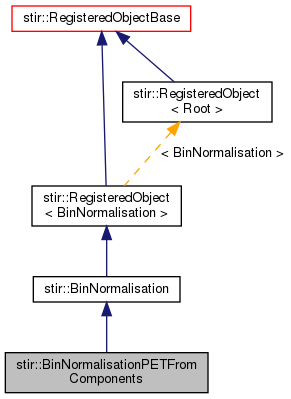
Public Member Functions | |
| std::string | get_registered_name () const override |
| Returns the name of the type of the object. | |
| BinNormalisationPETFromComponents () | |
| Default constructor. | |
| bool | is_trivial () const override |
| check if we would be multiplying with 1 (i.e. do nothing) | |
| Succeeded | set_up (const shared_ptr< const ExamInfo > &exam_info_sptr, const shared_ptr< const ProjDataInfo > &) override |
| Checks if we can handle certain projection data. | |
| void | apply (RelatedViewgrams< float > &viewgrams) const override |
| Normalise some data. | |
| void | undo (RelatedViewgrams< float > &viewgrams) const override |
| Undo the normalisation of some data. | |
| float | get_bin_efficiency (const Bin &bin) const override |
| Return the 'efficiency' factor for a single bin. | |
| void | allocate (shared_ptr< const ProjDataInfo >, bool do_eff, bool do_geo, bool do_block=false, bool do_symmetry_per_block=false) |
| Allocate the relevant factors. | |
| DetectorEfficiencies & | crystal_efficiencies () |
| GeoData3D & | geometric_factors () |
| BlockData3D & | block_factors () |
| void | set_defaults () override |
| Sets all factors to empty and flags that allocations need to be done. | |
| void | apply (ProjData &, shared_ptr< DataSymmetriesForViewSegmentNumbers >=shared_ptr< DataSymmetriesForViewSegmentNumbers >()) const |
| normalise some data | |
| void | undo (ProjData &, shared_ptr< DataSymmetriesForViewSegmentNumbers >=shared_ptr< DataSymmetriesForViewSegmentNumbers >()) const |
| undo the normalisation of some data | |
 Public Member Functions inherited from stir::BinNormalisation Public Member Functions inherited from stir::BinNormalisation | |
| virtual float | get_calibration_factor () const |
| virtual bool | is_TOF_only_norm () const |
| returns if the object can only handle TOF data | |
| void | apply (ProjData &, shared_ptr< DataSymmetriesForViewSegmentNumbers >=shared_ptr< DataSymmetriesForViewSegmentNumbers >()) const |
| normalise some data | |
| void | undo (ProjData &, shared_ptr< DataSymmetriesForViewSegmentNumbers >=shared_ptr< DataSymmetriesForViewSegmentNumbers >()) const |
| undo the normalisation of some data | |
| void | set_exam_info_sptr (const shared_ptr< const ExamInfo > _exam_info_sptr) |
| shared_ptr< const ExamInfo > | get_exam_info_sptr () const |
| Public Member Functions inherited from stir::ParsingObject | |
| ParsingObject (const ParsingObject &) | |
| ParsingObject & | operator= (const ParsingObject &) |
| bool | parse (std::istream &f) |
| bool | parse (const char *const filename) |
| void | ask_parameters () |
| virtual std::string | parameter_info () |
Protected Attributes | |
| DetectorEfficiencies | efficiencies |
| GeoData3D | geo_data |
| BlockData3D | block_data |
| Protected Attributes inherited from stir::BinNormalisation | |
| bool | _already_set_up |
| shared_ptr< const ProjDataInfo > | proj_data_info_sptr |
| KeyParser | parser |
checks if factors are initialised | |
| bool | has_crystal_efficiencies () const |
| bool | has_geometric_factors () const |
| bool | has_block_factors () const |
Additional Inherited Members | |
| Static Public Member Functions inherited from stir::RegisteredObject< BinNormalisation > | |
| static BinNormalisation * | read_registered_object (std::istream *in, const std::string ®istered_name) |
| Construct a new object (of a type derived from Root, its actual type determined by the registered_name parameter) by parsing the istream. | |
| static BinNormalisation * | ask_type_and_parameters () |
| ask the user for the type, and then calls read_registered_object(0, type) | |
| static void | list_registered_names (std::ostream &stream) |
| List all possible registered names to the stream. | |
| Protected Types inherited from stir::RegisteredObject< BinNormalisation > | |
| typedef BinNormalisation *(* | RootFactory) (std::istream *) |
| The type of a root factory is a function, taking an istream* as argument, and returning a Root*. | |
| typedef FactoryRegistry< std::string, RootFactory, interfile_less > | RegistryType |
| The type of the registry. | |
| Protected Member Functions inherited from stir::BinNormalisation | |
| virtual void | check (const ProjDataInfo &proj_data_info) const |
| check if the argument is the same as what was used for set_up() | |
| virtual void | check (const ExamInfo &exam_info) const |
| virtual void | initialise_keymap () |
| Initialise all keywords. | |
| virtual bool | post_processing () |
| This will be called at the end of the parsing. | |
| virtual void | set_key_values () |
| This will be called before parsing or parameter_info is called. | |
| Static Protected Member Functions inherited from stir::RegisteredObject< BinNormalisation > | |
| static RegistryType & | registry () |
| Static function returning the registry. | |
Detailed Description
A BinNormalisation class that uses component-based normalisation for PET.
Components currently supported are crystal efficiencies, geometric factors (constrained by symmetry) and block data. The latter were introduced to cope with timing alignment issues between blocks, but are generally not recommended in the current estimation process (by ML_estimate_component_based_normalisation) as the model allows for too much freedom.
The detection efficiency of a crystal pair is modelled as
![\[ \epsilon_i \epsilon_j g_{ij} B_{ij}
\]](form_62_dark.png)
with 


Symmetries for the geometric factors are described in
Niknejad, T., Tavernier, S., Varela, J. and Thielemans, K. Validation of 3D model-based maximum-likelihood estimation of normalisation factors for partial ring positron emission tomography. in 2016 IEEE Nuclear Science Symposium, Medical Imaging Conference and Room-Temperature Semiconductor Detector Workshop (NSS/MIC/RTSD) 1-5 (2016). doi:10.1109/NSSMIC.2016.8069577.
Note however that this describes rotational/translational symmetry per block, while the default is now to use symmetries per bucket ( see the do_symmetry_per_block argument of allocate()). (The block factors still work per block, not bucket).
This class does not actually set the relevant factors. That is left to external methods via the crystal_efficiencies(), geometric_factors() and block_factors() members. If they are not set, the factor is not applied (i.e. assumed to be 1).
The model is constructed for the "physical" crystals only. The "virtual" crystals are forced to have 0 detection efficiency.
- Todo
This class should probably be derived from BinNormalisationWithCalibration.
The class currently does not handle "compressed" projection data (i.e. span etc).
- Todo
- Currently, set_up() creates a ProjDataInMemory object with the PET detection efficiencies. This uses a lot of memory unfortunately.
Constructor & Destructor Documentation
◆ BinNormalisationPETFromComponents()
| stir::BinNormalisationPETFromComponents::BinNormalisationPETFromComponents | ( | ) |
Default constructor.
- Warning
- You should not call any member functions for any object just constructed with this constructor. Initialise the object properly first.
References BinNormalisationPETFromComponents(), and set_defaults().
Referenced by BinNormalisationPETFromComponents().
Member Function Documentation
◆ get_registered_name()
|
inlineoverridevirtual |
Returns the name of the type of the object.
Each type that can be parsed has a unique (within its hierarchy) name associated with it. This function returns that name. KeyParser::parameter_info() needs to know this name such that it can fill it in.
Implements stir::RegisteredObjectBase.
◆ is_trivial()
|
overridevirtual |
check if we would be multiplying with 1 (i.e. do nothing)
Checks if all data is equal to 1 (up to a tolerance of 1e-4). To do this, it checks if all components are 1.
Reimplemented from stir::BinNormalisation.
References stir::error(), and is_trivial().
Referenced by is_trivial().
◆ set_up()
|
overridevirtual |
Checks if we can handle certain projection data.
Compares the stored ProjDataInfo with the ProjDataInfo supplied.
Reimplemented from stir::BinNormalisation.
References stir::error(), stir::ProjDataInfo::get_max_axial_pos_num(), stir::ProjDataInfo::get_max_segment_num(), stir::ProjDataInfo::get_max_tangential_pos_num(), stir::ProjDataInfo::get_min_axial_pos_num(), stir::ProjDataInfo::get_min_segment_num(), stir::ProjDataInfo::get_min_tangential_pos_num(), stir::ProjDataInfo::parameter_info(), stir::BinNormalisation::set_up(), set_up(), and stir::warning().
Referenced by set_up().
◆ apply() [1/2]
|
overridevirtual |
Normalise some data.
This means divide with the efficiency model. 0/0 is set to 0.
Reimplemented from stir::BinNormalisation.
References apply(), stir::RelatedViewgrams< elemT >::begin(), stir::BinNormalisation::check(), stir::divide(), stir::RelatedViewgrams< elemT >::end(), stir::RelatedViewgrams< elemT >::get_basic_view_segment_num(), stir::DataWithProjDataInfo::get_proj_data_info_sptr(), and stir::RelatedViewgrams< elemT >::get_symmetries_ptr().
Referenced by apply().
◆ undo() [1/2]
|
overridevirtual |
Undo the normalisation of some data.
This means multiply with the efficiency model.
Reimplemented from stir::BinNormalisation.
References stir::BinNormalisation::check(), stir::RelatedViewgrams< elemT >::get_basic_view_segment_num(), stir::DataWithProjDataInfo::get_proj_data_info_sptr(), stir::RelatedViewgrams< elemT >::get_symmetries_ptr(), and undo().
Referenced by undo().
◆ get_bin_efficiency()
|
overridevirtual |
Return the 'efficiency' factor for a single bin.
With the notation of the class documentation, this returns the factor 
- Warning
- Some derived classes might implement this very inefficiently.
Implements stir::BinNormalisation.
References get_bin_efficiency().
Referenced by get_bin_efficiency().
◆ allocate()
| void stir::BinNormalisationPETFromComponents::allocate | ( | shared_ptr< const ProjDataInfo > | pdi_sptr, |
| bool | do_eff, | ||
| bool | do_geo, | ||
| bool | do_block = false, | ||
| bool | do_symmetry_per_block = false ) |
Allocate the relevant factors.
They are currently probably set to 0, but do not rely on this.
References allocate().
Referenced by allocate().
◆ set_defaults()
|
overridevirtual |
Sets all factors to empty and flags that allocations need to be done.
Also calls base_type::set_defaults()
Reimplemented from stir::BinNormalisation.
References stir::BinNormalisation::set_defaults(), and set_defaults().
Referenced by BinNormalisationPETFromComponents(), and set_defaults().
◆ apply() [2/2]
| void stir::BinNormalisation::apply | ( | ProjData & | proj_data, |
| shared_ptr< DataSymmetriesForViewSegmentNumbers > | symmetries_sptr = shared_ptr<DataSymmetriesForViewSegmentNumbers>() ) const |
normalise some data
This would be used for instance to precorrect unnormalised data. With the notation of the class documentation, this would divide by the factors
This just loops over all RelatedViewgrams.
The default value for the symmetries means that TrivialDataSymmetriesForBins will be used.
◆ undo() [2/2]
| void stir::BinNormalisation::undo | ( | ProjData & | proj_data, |
| shared_ptr< DataSymmetriesForViewSegmentNumbers > | symmetries_sptr = shared_ptr<DataSymmetriesForViewSegmentNumbers>() ) const |
undo the normalisation of some data
This would be used for instance to bring geometrically forward projected data to the mean of the measured data. With the notation of the class documentation, this would multiply by the factors
This just loops over all RelatedViewgrams.
The default value for the symmetries means that TrivialDataSymmetriesForBins will be used.
The documentation for this class was generated from the following files:
- /home/kris/devel/STIRdistrib/STIR/src/include/stir/recon_buildblock/BinNormalisationPETFromComponents.h
- /home/kris/devel/STIRdistrib/STIR/src/recon_buildblock/BinNormalisationPETFromComponents.cxx
Generated on Wed May 27 2026 17:04:06 for STIR by
 1.13.2