A class for storing viewgrams which are related by symmetry. More...
#include "stir/RelatedViewgrams.h"
typedefs for iterator support | |
| typedef std::random_access_iterator_tag | iterator_category |
| typedef Viewgram< elemT > | value_type |
| typedef value_type & | reference |
| typedef const value_type & | const_reference |
| typedef std::ptrdiff_t | difference_type |
| typedef std::size_t | size_type |
| typedef std::vector< Viewgram< elemT > >::iterator | iterator |
| typedef std::vector< Viewgram< elemT > >::const_iterator | const_iterator |
| RelatedViewgrams () | |
| default constructor (sets everything empty) | |
| RelatedViewgrams (const std::vector< Viewgram< elemT > > &viewgrams, const shared_ptr< DataSymmetriesForViewSegmentNumbers > &symmetries_used) | |
| a private constructor which simply sets the members | |
| int | get_basic_view_num () const |
| get 'basic' view_num | |
| int | get_basic_segment_num () const |
| get 'basic' segment_num | |
| int | get_basic_timing_pos_num () const |
| get 'basic' timing_pos_num | |
| ViewgramIndices | get_basic_view_segment_num () const |
| get 'basic' view_segment_num | |
| ViewgramIndices | get_basic_viewgram_indices () const |
| get 'basic' viewgram indices | |
| int | get_num_viewgrams () const |
| returns the number of viewgrams in this object | |
| int | get_num_axial_poss () const |
| int | get_min_axial_pos_num () const |
| int | get_max_axial_pos_num () const |
| const DataSymmetriesForViewSegmentNumbers * | get_symmetries_ptr () const |
| Get a pointer to the symmetries used in constructing this object. | |
| shared_ptr< DataSymmetriesForViewSegmentNumbers > | get_symmetries_sptr () const |
| Get a shared pointer to the symmetries used in constructing this object. | |
| void | grow (const IndexRange< 2 > &range) |
| Grow each viewgram. | |
| iterator | begin () |
| use to initialise an iterator to the first element of the vector | |
| iterator | end () |
| iterator 'past' the last element of the vector | |
| const_iterator | begin () const |
| use to initialise an iterator to the first element of the (const) vector | |
| const_iterator | end () const |
| iterator 'past' the last element of the (const) vector | |
| RelatedViewgrams & | operator*= (const elemT) |
| Multiplication of all data elements with a constant. | |
| RelatedViewgrams & | operator/= (const elemT) |
| Division of all data elements by a constant. | |
| RelatedViewgrams & | operator+= (const elemT) |
| Addition of all data elements by a constant. | |
| RelatedViewgrams & | operator-= (const elemT) |
| Subtraction of all data elements by a constant. | |
| RelatedViewgrams & | operator*= (const RelatedViewgrams< elemT > &) |
| Element-wise multiplication with another RelatedViewgram object. | |
| RelatedViewgrams & | operator/= (const RelatedViewgrams< elemT > &) |
| Element-wise division by another RelatedViewgram object. | |
| RelatedViewgrams & | operator+= (const RelatedViewgrams< elemT > &) |
| Element-wise addition by another RelatedViewgram object. | |
| RelatedViewgrams & | operator-= (const RelatedViewgrams< elemT > &) |
| Element-wise subtraction by another RelatedViewgram object. | |
| elemT | find_max () const |
| Find the maximum of all data elements. | |
| elemT | find_min () const |
| Find the maximum of all data elements. | |
| void | fill (const elemT &n) |
| Set all data elements to n. | |
| RelatedViewgrams | get_empty_copy () const |
| Return a new object with ProjDataInfo etc., but all data elements set to 0. | |
Equality | |
| class | ProjData |
| class | ProjDataInfo |
| bool | has_same_characteristics (self_type const &, std::string &explanation) const |
| Checks if the 2 objects have the proj_data_info, segment_num etc. | |
| bool | has_same_characteristics (self_type const &) const |
| Checks if the 2 objects have the proj_data_info, segment_num etc. | |
| bool | operator== (const self_type &) const |
| check equality (data has to be identical) | |
| bool | operator!= (const self_type &) const |
| negation of operator== | |
Additional Inherited Members | |
 Public Member Functions inherited from stir::DataWithProjDataInfo Public Member Functions inherited from stir::DataWithProjDataInfo | |
| DataWithProjDataInfo () | |
| Default constructor sets internal member to 0. | |
| DataWithProjDataInfo (const shared_ptr< const ProjDataInfo > &proj_data_info_sptr_v) | |
| virtual const ProjDataInfo & | get_proj_data_info () const |
| virtual shared_ptr< const ProjDataInfo > | get_proj_data_info_sptr () const |
| Get shared pointer to ProjData info. | |
| int | get_num_segments () const |
| Get number of segments. | |
| int | get_num_axial_poss (const int segment_num) const |
| Get number of axial positions per segment. | |
| int | get_num_views () const |
| Get number of views. | |
| int | get_num_tangential_poss () const |
| Get number of tangential positions. | |
| int | get_num_tof_poss () const |
| Get number of TOF positions. | |
| int | get_min_tof_pos_num () const |
| Get the index of the first timing position. | |
| int | get_max_tof_pos_num () const |
| Get the index of the last timing position. | |
| int | get_tof_mash_factor () const |
| Get TOG mash factor. | |
| int | get_min_segment_num () const |
| Get minimum segment number. | |
| int | get_max_segment_num () const |
| Get maximum segment number. | |
| int | get_min_axial_pos_num (const int segment_num) const |
| Get mininum axial position per segmnet. | |
| int | get_max_axial_pos_num (const int segment_num) const |
| Get maximum axial position per segment. | |
| int | get_min_view_num () const |
| Get minimum view number. | |
| int | get_max_view_num () const |
| Get maximum view number. | |
| int | get_min_tangential_pos_num () const |
| Get minimum tangential position number. | |
| int | get_max_tangential_pos_num () const |
| Get maximum tangential position number. | |
| Protected Attributes inherited from stir::DataWithProjDataInfo | |
| shared_ptr< const ProjDataInfo > | proj_data_info_sptr |
Detailed Description
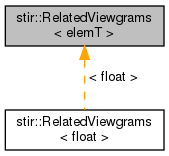
class stir::RelatedViewgrams< elemT >
A class for storing viewgrams which are related by symmetry.
Constructor & Destructor Documentation
◆ RelatedViewgrams()
|
inline |
a private constructor which simply sets the members
- Todo
- Currently public for the STIR_MPI version
Member Function Documentation
◆ get_basic_view_num()
|
inline |
get 'basic' view_num
see DataSymmetriesForViewSegmentNumbers for definition of 'basic'
Referenced by stir::BackProjectorByBinUsingProjMatrixByBin::actual_back_project(), and has_same_characteristics().
◆ get_basic_segment_num()
|
inline |
get 'basic' segment_num
see DataSymmetriesForViewSegmentNumbers for definition of 'basic'
Referenced by stir::BackProjectorByBinParallelproj::actual_back_project(), stir::BackProjectorByBinUsingProjMatrixByBin::actual_back_project(), stir::FBP3DRPReconstruction::do_colsher_filter_view(), and has_same_characteristics().
◆ get_basic_timing_pos_num()
|
inline |
get 'basic' timing_pos_num
see DataSymmetriesForViewSegmentNumbers for definition of 'basic'
Referenced by stir::BackProjectorByBinUsingProjMatrixByBin::actual_back_project(), stir::BinNormalisationFromProjData::apply(), stir::BinNormalisationFromProjData::undo(), and stir::zoom_viewgrams().
◆ get_basic_view_segment_num()
|
inline |
get 'basic' view_segment_num
- Deprecated
- Use get_basic_viewgram_indices() instead.
References get_basic_viewgram_indices().
Referenced by stir::BinNormalisationFromML2D::apply(), stir::BinNormalisationFromProjData::apply(), stir::BinNormalisationPETFromComponents::apply(), stir::BackProjectorByBin::back_project(), stir::BinNormalisationFromML2D::undo(), stir::BinNormalisationFromProjData::undo(), stir::BinNormalisationPETFromComponents::undo(), and stir::zoom_viewgrams().
◆ get_basic_viewgram_indices()
|
inline |
get 'basic' viewgram indices
see DataSymmetriesForViewSegmentNumbers for definition of 'basic'
Referenced by get_basic_view_segment_num().
◆ get_symmetries_sptr()
|
inline |
Get a shared pointer to the symmetries used in constructing this object.
- Warning
- It is dangerous to modify the shared symmetries object
◆ grow()
| void RelatedViewgrams< elemT >::grow | ( | const IndexRange< 2 > & | range | ) |
Grow each viewgram.
This function is necessary because it modifies the size of each viewgram sequentially. This is not allowed by an external function, and leads to different proj_data_info_ptrs anyway. So, it would be caught by an assert at some point.
References begin(), end(), stir::VectorWithOffset< T >::get_max_index(), stir::VectorWithOffset< T >::get_min_index(), stir::DataWithProjDataInfo::get_proj_data_info_sptr(), grow(), and stir::IndexRange< num_dimensions >::is_regular().
Referenced by stir::FBP3DRPReconstruction::do_grow3D_viewgram(), and grow().
◆ operator*=() [1/2]
| RelatedViewgrams< elemT > & RelatedViewgrams< elemT >::operator*= | ( | const elemT | f | ) |
Multiplication of all data elements with a constant.
- Warning
- : this uses multiplication according to elemT (careful for overflow for integer types!)
References begin(), end(), and operator*=().
Referenced by operator*=(), and operator*=().
◆ operator/=() [1/2]
| RelatedViewgrams< elemT > & RelatedViewgrams< elemT >::operator/= | ( | const elemT | f | ) |
Division of all data elements by a constant.
- Warning
- : this uses division according to elemT (i.e. no rounding or so)
References operator/=().
Referenced by operator/=(), and operator/=().
◆ operator+=() [1/2]
| RelatedViewgrams< elemT > & RelatedViewgrams< elemT >::operator+= | ( | const elemT | f | ) |
Addition of all data elements by a constant.
- Warning
- : this uses addition according to elemT (careful with overflow with integer types!)
References begin(), end(), and operator+=().
Referenced by operator+=(), and operator+=().
◆ operator-=() [1/2]
| RelatedViewgrams< elemT > & RelatedViewgrams< elemT >::operator-= | ( | const elemT | f | ) |
Subtraction of all data elements by a constant.
- Warning
- : this uses subtraction according to elemT (careful with unsigned types!)
References operator-=().
Referenced by operator-=(), and operator-=().
◆ operator*=() [2/2]
| RelatedViewgrams< elemT > & RelatedViewgrams< elemT >::operator*= | ( | const RelatedViewgrams< elemT > & | arg | ) |
Element-wise multiplication with another RelatedViewgram object.
- Warning
- : this uses multiplication according to elemT (careful for overflow for integer types!)
References begin(), end(), get_num_viewgrams(), operator*=(), and RelatedViewgrams().
◆ operator/=() [2/2]
| RelatedViewgrams< elemT > & RelatedViewgrams< elemT >::operator/= | ( | const RelatedViewgrams< elemT > & | arg | ) |
Element-wise division by another RelatedViewgram object.
- Warning
- : this uses division according to elemT (i.e. no rounding or so)
References begin(), end(), get_num_viewgrams(), operator/=(), and RelatedViewgrams().
◆ operator+=() [2/2]
| RelatedViewgrams< elemT > & RelatedViewgrams< elemT >::operator+= | ( | const RelatedViewgrams< elemT > & | arg | ) |
Element-wise addition by another RelatedViewgram object.
- Warning
- : this uses addition according to elemT (careful with overflow with integer types!)
References begin(), end(), get_num_viewgrams(), operator+=(), and RelatedViewgrams().
◆ operator-=() [2/2]
| RelatedViewgrams< elemT > & RelatedViewgrams< elemT >::operator-= | ( | const RelatedViewgrams< elemT > & | arg | ) |
Element-wise subtraction by another RelatedViewgram object.
- Warning
- : this uses subtraction according to elemT (careful with unsigned types!)
References begin(), end(), get_num_viewgrams(), operator-=(), and RelatedViewgrams().
◆ has_same_characteristics() [1/2]
| bool RelatedViewgrams< elemT >::has_same_characteristics | ( | self_type const & | other, |
| std::string & | explanation ) const |
Checks if the 2 objects have the proj_data_info, segment_num etc.
If they do not have the same characteristics, the string explanation explains why.
References get_basic_segment_num(), get_basic_view_num(), stir::DataWithProjDataInfo::get_proj_data_info_sptr(), get_symmetries_ptr(), and has_same_characteristics().
Referenced by has_same_characteristics(), and has_same_characteristics().
◆ has_same_characteristics() [2/2]
| bool RelatedViewgrams< elemT >::has_same_characteristics | ( | self_type const & | other | ) | const |
Checks if the 2 objects have the proj_data_info, segment_num etc.
Use this version if you do not need to know why they do not match.
References has_same_characteristics().
◆ operator==()
| bool RelatedViewgrams< elemT >::operator== | ( | const self_type & | that | ) | const |
check equality (data has to be identical)
Uses has_same_characteristics() and Array::operator==.
- Warning
- This function uses
==, which might not be what you need to check whenelemThas data with float or double numbers.
References operator==().
Referenced by operator==().
The documentation for this class was generated from the following files:
- /home/kris/devel/STIRdistrib/STIR/src/include/stir/analytic/FBP3DRP/FBP3DRPReconstruction.h
- /home/kris/devel/STIRdistrib/STIR/src/include/stir/RelatedViewgrams.h
- /home/kris/devel/STIRdistrib/STIR/src/buildblock/RelatedViewgrams.cxx
- /home/kris/devel/STIRdistrib/STIR/src/include/stir/RelatedViewgrams.inl
Generated on Wed May 27 2026 17:04:07 for STIR by
 1.13.2